
Led by top technology partners and industry pioneers
Event:
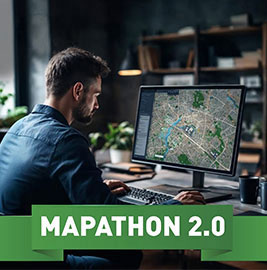
Mapathon 2.0
About:
Mapping solutions for smart cities
Prize:
₹ 1,50,000
Format
In-person
Event Overview
The Mapathon is a collaborative map-making competition focused on the creation of thematic maps using real-world geospatial data. Organised by the University Centre for Research and Development, Chandigarh University, the event invites Indian national students to participate in the hands-on mapping initiative. The objective is to develop innovative methods that improve map accuracy, relevance, and usability for communities. Participants will work with open geospatial datasets using free and open-source tools such as QGIS.
The competition will also encourage the practical application of maps across key thematic areas while building participants ability to customise geospatial outputs for societal impact. Maps will be created using observation data, remote sensing inputs, and crowdsourced datasets, highlighting their potential in sectors such as agriculture, climate studies, disaster management, rural and urban planning, and national resource mapping. Through this initiative, the Mapathon seeks to empower Indian youth with skills that support informed decision-making and future development pathways.
Objectives
Enhance accuracy, usability, and adoption of thematic maps
Promote data-driven decision-making using geospatial technologies
Build capacity in GIS, Remote Sensing, and Spatial Analytics
Encourage innovation using open-source mapping tools like QGIS
Enable participants to apply geospatial insights to real-world societal problems
Contribute towards national geospatial capacity building
Prizes
Total Prize Pool: 3.5 Lakh
• Winners and shortlisted teams will receive certificates and recognition during CU InnovFest
Who Can Participate?
Students, research scholars, and faculty from Science and Engineering disciplines
Graduates from relevant or allied domains
Professionals working in the geospatial or GIS industry
Mode of Event
Phase 1: Online
Phase 2 & Phase 3: Offline
Schedule & Timeline
Activity | Date |
Phase 1 (Online) | |
Notification Circulation | 25th December 2025 |
Team Registration Deadline | 31 st January 2026 |
Proposal Submission | 5th February 2026 |
Shortlisting of Top 30 Teams | 10 February 2026 |
Phase 2 & 3 (On-Campus) | 20th February 2026 to 21st February 2026 |
Key Benefits & Opportunities
Gain hands-on experience with real-world geospatial datasets, strengthening practical GIS and mapping skills
Develop industry-relevant expertise in GIS, Remote Sensing, Spatial Analytics, and Thematic Mapping
Apply geospatial technologies to solve real societal challenges in areas like agriculture, climate change, disaster management, urban planning, and public infrastructure
Showcase your work on a national-level platform, enhancing academic visibility and strengthening research and professional profiles
Receive expert mentorship and evaluation from academicians, GIS professionals, and industry specialists
Networking opportunities with researchers and industry professionals from GIS, geospatial analytics, and spatial planning sectors nationwide
ThemesCivil Engineering & Earth Sciences
Hydrology
Groundwater
Geology
Mining GIS case study
Soil GIS case study
Glacier
Land Use/Land Cover of Indian Districts
Municipal GIS case study
Transport
Real Estate GIS case study
Computer Science & Electronics
Artificial Intelligence and Machine Learning
Digital Image Processing
Application of computer vision algorithms in Remote sensing and GIS
Telecommunication GIS case study
Transmission GIS case study
Agriculture
Crop/plantation-type map
Stubble burning
Drone
Architecture
Urban planning and design
Cultural heritage assessment
Problem StatementsMapping of Natural Resources and Man-Made Features
Forests, Rivers, Minerals, Infrastructure, and Urban Utilities
Natural Resource Change Detection
Spatio-temporal analysis of Forests, Water, Land, and Urban Growth
Land Use/Land Cover (LULC) Change Analysis
Identification of LULC change hotspots using Bhuvan LULC datasets
Flood Hazard and Flood Inundation Mapping
Riverine, urban, and flash flood susceptibility and risk maps
State-wise Health Care Indicator Mapping
Spatial analysis of Hospitals, Doctors, Beds, and Accessibility
Agricultural and Cultivation Mapping
Crop Patterns, Irrigation Coverage, and Seasonal Variability
Road Network, Road Quality, and Drainage Mapping
Transportation Accessibility and Urban Drainage Efficiency
Land Degradation and Soil Erosion Mapping
Identification of Degraded Lands and Vulnerable Regions
Health Infrastructure, Population and Vaccination Mapping
Age-wise Population, Vaccination Coverage, and Service Gaps
Change Detection in Waterbodies, Reservoirs, and Wetlands
Monitoring shrinkage, expansion, and seasonal variability
Amenities Mapping
Schools, Hospitals, Parks, Public Services, and Utilities
Water Source and Water Quality Mapping
Surface/Groundwater Sources and Contamination Risk Zones
Population Crowding and Traffic Hotspot Mapping
Urban Congestion, Crowd Density, and Mobility Analysis
Telecommunication and Network Coverage Mapping
Identification of connectivity gaps and service availability
Local Markets, Produce, and Employment Mapping
Spatial distribution of economic activity and livelihoods
Waste Segregation and Collection Point Mapping
Solid Waste Management and Sanitation Planning
Mapping Places of Cultural and Heritage Importance
Temples, Monuments, Heritage Sites, and Tourism Mapping
Innovative Geospatial Solutions aligned with Indian Societal, Environmental, Urban, or Disaster-Related challenges

Get Tickets